Reading Fanatic Reviews
All Nonfiction ReviewsLlewellyn’s Little Book of Tarot by Barbara Moore
Available at Amazon, Barnes & Noble, Kobo, Scribd, Mondadori, Angus & Robinson, and Indigo (Chapters)
Llewellyn's Little Book of Tarot*
Nuggets of Insight into the Tarot
This small book is a fun introduction that gets you thinking about tarot in different ways, whether you’re a novice or more experienced. Its structure is simple, much like you would believe, with early sections on the history of the tarot as well as structure and symbolism. The bulk of the book is about the cards themselves, a page for each, naturally divided into the major and minor arcana. The book ends with a section on how to do readings and layouts and is followed by one about other activities you can do with them. The book has a fantastic further reading section, listing both classic and newer books on tarot, where she not only gives the book title and author but also a sentence about the book’s topic. The table of contents is helpful because it gives the page numbers of all the different extra information in the book, like the tips, prompts, and exercises.
For each of the card pages, there is a picture from a contemporary tarot deck and keywords with a paragraph or two about the card in general followed by either an exercise, tarot tips, information about symbolism, or a journal prompt. Each page about a card ends with a line or two that will give you an instant answer if you use the book for bibliomancy, where you flip open to a random page of a book for an answer to a simple question. There are eight exercises altogether, including the bibliomancy mentioned above, figuring out your birth card, choosing a card of the day, journaling with tarot, and creating affirmations. There are 41 tarot tips scattered throughout the book. The topics range widely, as you might imagine from the number of them. Sometimes she talks about groups of cards, like the court cards; other times, she discusses working with the tarot, like what to do when cards are confusing or working with reversals (if you choose) and negative meanings. The symbolism tips sometimes focus on a very specific element in a specific card, like the Fool’s dog, or a specific card’s symbolism more in-depth. The symbolism of abstract notions like grief or justice is also addressed. The journal prompts are, as you might imagine, based on the particular card it is attached to, like mother issues for the Empress and rebirth for Judgment.
I really liked having exposure to so many contemporary tarot decks. While I own quite a few, as I’ve studied the tarot for over 30 years, I’m not as familiar with what’s currently available as I might be. Some of these decks are quite beautiful, and I might have to research a few to add to my collection. Having worked with the tarot for so long, I was surprised that this little book actually had me thinking about my work with the cards differently at times. Some concepts were wholly new to me, like using different decks for different types of questions or readings. I might have to try that. I liked her brief descriptions of the cards; it is clear the author has studied tarot wide and deep, and her viewpoint on it is very open and uplifting. I will definitely be incorporating some of her ideas into how I use my cards.
In all, I found this to be a delightful little book that will spark many an idea and insight into my work with the tarot.
Dear Time, Are You on My Side? by Ky-Lee Hanson
Available at Amazon, iBooks, Kobo, Scribd, Angus & Robertson, and Indigo (Chapters).
Dear Time, Are You on My Side?*
Gets You Thinking Differently about Time
This amazing book will have you examining the concept of time from a variety of perspectives that will help give you clarity on your own relationship with time, how you can make it more fluid, and how the passage of time is immaterial to your wants and needs as you grow and mature within your own self, in your relationships, in what you choose to do, and in your purpose in life. The book creator has brought together 19 women with unique relationships and insights into time based on their own life experience. The book is divided into five sections: What is Time?, Age Ain’t Nothing but a Number, Fear is a Time Robber, Heartbeat to Heartbeat, and Change the Course of Time. The end of each section has a place for you to reflect on all the concepts of the part as well as free journal; at the end of the book, you’re given space to rewrite your life from a new perspective on time.
Each of the authors shares a part of their own story, reflecting on time and what it has meant, means, and will mean to them. They talk about shifts in perspective and knowledge gained. Some of these are dense reads, while others are very straightforward to get through. I found all to be valuable, and each got me thinking. The exercises at the end of each section help anchor the concepts that have been discussed and give clarity on what they can mean to help you live your best life.
Here are some topics in the book: Living Timelessly–Ego and Time are Not our Enemies; Managing the Me in Time; But When is the Timing in Life Ever Right?; Life, Not According to Plan; The Wait is Over… Your Time is Now; and A Premature Lesson in the Value of Time.
If you find yourself grappling with issues of time, from time management to greater concepts like feeling like you’re running out of time because of your age, this book will give you a more in-depth perspective and a way to reframe the concept of time is so that we end the struggle with it and instead work with as we evolve on our road to becoming the best person we can be.
Woozie (Grandmother) Wisdom by Lynn Hubschman
Available at Amazon, Barnes & Noble, iBooks, Kobo, 24 Symbols, Mondadori, Angus & Robertson, and Indigo (Chapters)
Woozie (Grandmother) Wisdom*
Life, Sex, and Love Advice from Therapist and Grandmothter
The author is both a grandmother and a professional therapist with a career spanning 30 years focusing on relationships and sex. As the subtitle suggests, the book is divided into three sections: life, sex, and love. Each section is further divided into short, vaguely interrelated articles headed by an interesting quote. The author shares her personal experience and professional wisdom about each topic. The life section looks at things from parenting to stress to grieving. The sex section looks at the emotional meaning and relationship enhancing aspects of it as well as sexual practices. Finally, the love section covers such topics as dating, control, and how men and woman can perceive each other wrong.
There were some issues with grammar, punctuation, and usage. The author seems to have an eclectic style with a love of semicolons that sometimes impeded meaning or impact. Word choice was at times odd or wrong. For instance, I believe there was a place where she meant to say that a man was concerned about being virile rather than virulent.
The author frankly discusses all these topics, so if you’re a little squeamish about reading about the details of sex and sexual practices, this aspect of the book may make you feel uncomfortable. She discusses some generational differences with each of the topics as well. Imagine It must be interesting to grow up with a mother who was a relationship and sex counselor; I wonder if it is as surreal for her grandchildren as I imagine it would be!
Mini Style Guide by Denise O’Hagan
Available at Amazon, Barnes & Noble, iBooks, Kobo, 24 Symbols, Mondadori, Angus & Robertson, and Indigo (Chapters)
Mini Style Guide*
OK as Far as It Goes
I’m an editor myself, so I was curious about what this book would have to say about style. The book is divided into three parts. The first part is the largest and has to do with good writing—like how to write in plain English, commonly misused words, and copyright—as well as a punctuation guide. The second section looks at manuscript presentation while the final section gives a brief look at the publishing industry today (traditional vs. self-publishing). The appendix at the back has letters and forms that were mentioned in the main text.
The author is Australian. There are sections in the front that discuss British vs. American English, not just the one that is entitled that. I am an American myself, so I found her examples of American English sometimes to be inaccurate, like the discussion about sneakers and gym shoes. At least where I live in the western United States, we rarely call them sneakers; we are more apt to say tennis shoes or tennies. In one example that I thought was rather amusing, she stated that Americans are more prone to turn brand names into verbs, but then the example she gave of such a transformation is one that is never said in America; it’s a British term.
As an editor, I had hopes that this book would be something I could recommend to my clients to help them understand how to approach style and good writing better. I thought the initial sections of the book didn’t directly apply to what most writers want or need today. In the parts that would be most applicable, the descriptions were either too wordy or not explanatory enough. I would have liked this book to have been something an author could just pick up, flip to a particular question about style and find a quick, easy, and applicable answer to get them going on their way.
I think, too, that Americans could be confused by the style used in this book itself. Perhaps we need a streamlined guide similar to this but written by an American editor so that the gap between what the writer should be going for and what the writer reads in the guide isn’t so large.
For a book about style that has been edited, there were inconsistencies about punctuating the examples. Some of these examples seem like complete sentences but didn’t have periods, or full stops as this author would say. I thought that the sections on manuscript presentation and publishing were too short to be of much use.
The Little Book of Self Help Quotes by K. N. Ormond
No Universal Book Link
Available?
Review Left On Amazon,
Then Couldn’t Find Page
The Little Book of Self Help Quotes*
Unattributed Quotes in Book Riddled with Errors
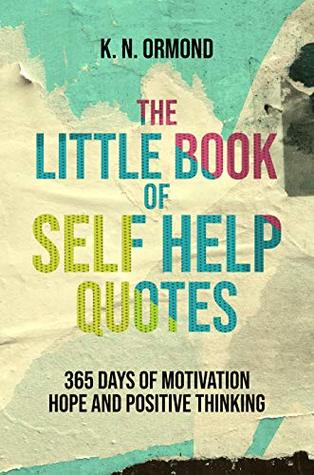
This book compiles 365 days’ worth of self-help quotes ranging from happiness to communication to success. With each quote, the author gives a line or two which is meant to assist you to think about the quote.
The quotes themselves range from inspiring to not so inspiring. The short line or two that the author gives I think is revelatory of what the author personally thinks of the quote; many of these quotes could be taken in multiple ways, and you could actually do a deep dive on many of them that aren’t really reflected in what the author states. Some of these quotes did sound familiar, so I wondered who actually said the quotes. Unfortunately, the author does not give any sources for all these words of wisdom. I looked up a handful, and several were from Helen Keller, at least one was from Dr. Wayne Dwyer, and another was from a business guru from the last century named Napoleon Hill. I find myself wondering at the legality of this book where such a large part is quotes from others that are unattributed. Is it plagiarism? On another unfortunate note, the book had many issues with grammar, punctuation, and usage. Periods were often missing at the end of sentences, both within the quotes and the author’s write up. For the quotes themselves, the author used both single quotes and double quotes; no consistency. Commas were not used appropriately.
I think this book needed a short introduction. Perhaps the author could have shared his or her personal relationship to these quotes (has the author’s life been changed by them?), what the author hopes the reader will gain from it, basic instructions how to work with the quotes as well as perhaps ways to dive deeper if you want to. I think the need for basic instructions on an introductory page is crucial for this book because the instructions to “record your answer” were repetitive and unnecessary in the beginning and then missing at the end (again, consistency issues). I think that the simple instruction of record your answer doesn’t add much value for the reader. It might have been better to suggest in an introductory section to keep a journal of your thoughts about these quotes: looking back, looking forward, applying to your personal life or job, etc. The author could have set the framework for interaction with these quotes. I also thought that each quote needed more than a line or two to help draw the reader to gain inspiration. The author could have easily written a couple of paragraphs about each quote. She or he could have gotten personal, saying what this quote has meant in his or her life. Or he or she could have suggested a surface interaction with the quote and then a deeper dive into what the quote means or could mean in a person’s life.
Your Rebel Plans by Tikiri Herath
Available at Amazon, Barnes & Noble, iBooks, Kobo, Scribd, Mondadori, Angus & Robertson, and Indigo (Chapters)
Your Rebel Plans*
Part Two of Living Your Best Life
I was lucky enough to have reviewed the first book of this three book series, Your Rebel Dreams, which I loved for how it gets you focused on your values and vision. The author continues the Rebel Diva series with another exceptional book to help you figure out how to bring your dreams into fruition with goals and a solid plan. As in the other book, the author is teacher and cheerleader. She gives solid guidelines to help you figure out your goals and action plans, and she truly comes across as someone who cares whether or not you’re able to do what this book lays out.
The book is structured thus: a long introductory section on a variety of topics meant to get you ready for the process, the core of the book split into weeks with concrete goals for each week, and a wrap-up section. The first portion is meant to knock down barriers and build confidence through structured exercises. The weekly part that follows is broken down into making smart goals, making an action plan to achieve those goals, checking in to see how you are doing, and how to get it done. At the end of each week, there is a little check-in section to see how you’re feeling about the process. The final section is something I think has great power even though it is short. I love the ideas of making a pledge to yourself and having long-term check-ins and reevaluations.
The author is so supportive that I think this series is worthwhile for any woman who wants to coalesce what her dreams are and bring them to fruition so she can have the life that she wants. It is a beautiful process that has been outlined by a caring person who has clearly walked the talk. She adds fantastic freebies that enhance the book, like a printable PDF that you can use as you follow along as well as a free book about busting your fears. The author means to empower women to live openly and joyously aligned with their values, and I think she has created a series that can do just that.
The Stress Eating Solution by Laurel Mellin
Available at Amazon only
Free with Kindle Unlimited
The Stress Eating Solution*
Rewire Your Brain
This book purports to help you quit stress eating—which the author loosely defines as eating nonhealthful foods when you’re not hungry for emotional reasons like pleasure, comfort, love, or fear—by using the brain’s inherent neuroplasticity to rewire itself into more healthy, authentic constructs. For those of you who aren’t familiar with the concept of neuroplasticity, it simply means that our brains are more adaptable and easier to change than we think. The brain has billions of neurons that make physical connections that allowed us to think, feel, move, and do everything in life. These neurons fire together in patterns to bring up memories, make us move, and organize our thoughts, amongst other activities.
I am an RN, and neuroplasticity was something that interested me while I was in nursing school. I read quite a bit about it. Our brains are amazing organs that have truly untapped potential.
So, when I found out this book had to do with neuroplasticity and what the author calls “emotional brain training,” I was curious. In the Welcome section of the book, she describes some structures of the brain and recent thoughts on brain science. She credits those from whom her ideas spring. While she tries to simplify it, the descriptions do get a little technical at times. In this Welcome section, she also set up some concepts like a joy inventory. Before you start the first 30 days of the program, she also has you tell your story of weight and overeating so you can work with your personal narrative in the pages that follow; she then tells you how to set up the practice that you will be following over the two months of the program and afterward.
The work that is meant to be done over the first month takes up the bulk of the book. In this section, she gives you tools to better understand yourself, to incorporate joy, and to work on specific circuits that have to do with eating and releasing weight. Each day is divided into a mini-essay about the topic of the day, why it is important, how to do, other little tips and insights, and a checklist of what precisely you should do that day.
The scientific aspect of the work is not the only potentially difficult concept that you will have to work with. It is clear the author has been working with this training for a long time—I believe she is one of the founders of EBT—so she has created a lot of jargon and buzzwords to describe EBT concepts, tools, and practices. Even some regular words, like sanctuary and freedom—are given special meaning within this system. The book, I believe, really needs a glossary so that you can more easily dial in on the precise definitions of these concepts as you are working through them each day. I found this particularly confusing in the Using Tech to Connect section, where she tells you ways to connect (which appear to be an integral part of the process). There is a lot of jargon there that has not been introduced so that it is actually meaningless to read it before you dive into the rest of the book. A brief glossary in that connection section would have been helpful or a few words that describe each EBT buzzword or phrase within the suggestions themselves would be useful as well as a glossary at the beginning or end of the book that can be easily flipped to.
At the beginning of the book, she states that each day’s work on this process should take about 10 minutes. This is definitely not true. It might take you that long or less to read about the days topic but to actually implement it will often take continuous work throughout the day or more than 10 minutes at a given time.
The book has some of the common problems with grammar, punctuation, spelling, and usage. The book is said to have two editors, but I am curious whether there was an actual copyeditor and/or proofreader.
One thing that the author should fully disclose on whatever book sites she sells this on—and I am letting you know here—is that her website in support of this book is a membership site. While the connections that she says are essential to this process can be made if you find like-minded people interested in the program, she definitely promotes her website’s telegroups and app. I’m not sure if the app is free, as I haven’t looked at it, but nothing else is. At the time that I write this, the price for different levels of what you might need or want range from $39 to $699.
All that said, I find the concept of this book fascinating and wonder at its efficacy. I am tempted to try it out—my own personal free version—but I am unsure if I will truly be able to devote the time that I believe it will actually take to do correctly.
Pocahontas and the English Boys by Karen Ordahl Kupperman
Available at Amazon, Barnes & Noble, iBooks, Kobo, 24 Symbols, Mondadori, Angus & Robertson, and Indigo (Chapters)
Pocahontas and the English Boys*
Insight into Early Colonial America
Pocahontas and the English Boys gives a unique perspective on the earliest days of the English settlements in North America. As the title suggests, the lens is on a group of young people, and these children acted as go-betweens between the adults of both of their cultures. Pocahontas, as the beloved daughter of Chief Powhatan, was often sent to the English settlements as an emissary and message bearer. The English boys referred to in the title are less well-known to history. These young boys were specifically given to the Native Americans. Usually, these children were seen almost as adopted children of the tribal leaders and were treated with kindness and honor. In fact, there is some description of how these children would join the tribe, learning the language and culture and even dressing as Native Americans. They were treated well by the Native Americans, probably better than they would have fared in the English settlement, where they would have been seen more like servants.
Despite the title of the book, very little emphasis is actually given to Pocahontas and the English boys. Much of the book sets up the historical and cultural contexts of both the peoples (English and Native American) and the places. There is some discussion of the social milieu of England itself, the structure of Native American culture around the Jamestown area and the Algonquin tribes, and descriptions of early life in a variety of settlements, including some predating Pocahontas. Interactions between the native tribes and the Europeans are described in detail, with quotes from the sources themselves.
I found this to be a very fascinating look at the very earliest days of European settlement on the Eastern seaboard.
A Morning Routine by Lola R. Marie
Available at Amazon only
Free with Kindle Unlimited
A Morning Routine*
Start the Day off Right
The author shares her thoughts and ideas about the importance of the creation of a good morning routine. In the introduction, she states that she has struggled with her daily routine in general, but setting up a solid morning routine has been helpful. She’s open about her successes and failures; she tested out a variety of ideas while she was figuring this out in her own life. The latter half of the book is meditations that you can incorporate into your morning routine. The first section is eight chapters that first discuss the waking up process and the benefits of a morning routine. She spends some time discussing the sleep environment because good sleep is the foundation for a good morning. As an insomniac, I can tell you that it is true. Then, she starts talking about the elements of what could make up your morning routine, like waking up your body with exercise or your mind with meditation or journaling as well as some thoughts on grooming. She wraps up this section of the book by discussing how to create your own personal routine and telling you how you may be able to extend the routine to others you happen to live with.
When I first started reading the book, I almost felt a little overwhelmed at all she suggested, with the chapters on fitness/exercise, meditation, and grooming as well as the meditations. That’s a lot to pack into a morning! Luckily in the Creating Your Routine chapter, she suggests starting small, maybe first waking up just a little earlier or adding one concept to what you already do. She states throughout the book that setting up a morning routine actually makes her later day more productive. Not only because you might opt to prioritize your day during your routine, but also due to the fact that if you give structure to the start of your day, then you flow naturally into having more structure as the day progresses.
This is a fascinating concept. I do have a semi-routine for when I awaken but hadn’t really thought to nail it down precisely and follow it more days than not. I find myself intrigued as to whether or not the benefits she suggests are real, and I might be tempted to give this a try.
Emotional Intelligence by James W. Williams
Available at Amazon only
Free with Kindle Unlimited
Emotional Intelligence*
Error-Filled Rehash of EI Concepts, Not a Mental Makeover
In this book, the author purports to give you a 21-day roadmap to improving your emotional intelligence. The book’s cover showing the title and subtitle do not wholly and accurately reflect what goes on in the book. From them, it appears that the book is about emotional intelligence on a personal level, but it is primarily about how to understand emotion in yourself and others as it relates to business.
I am a female, so something irritated to hear the author talk about mastering or managing emotions. To me, that is not what emotions are about; can one master or manage untamed nature? While we can strive to better understanding, we cannot. While I agree that self-awareness of your emotional state has value, I don’t think it should follow that knowledge about emotions should be a springboard to manipulate the emotions of others, which it seems this author suggest. In part one of the book, it seems odd to me that he equates “people skills” with emotional intelligence. People skills, as it were, are so much more than anything to do with emotion. Similarly, the phrase emotional intelligence suggests more than just people skills.
In reading through it, it didn’t come together as a “mental makeover” plan at all; rather, it is more like a collection of short essays about EI topics. I think this book needs a more precise vision or perhaps a different one. The cover should actually reflect with a book is about, for certain. I think it should be more tightly focused on what the author seems to care about, which is how emotions can be used effectively in the workplace as another tool for management and workers. Perhaps he even needs two books, one for the worker bee and one for leaders. The book could have used the hand of a developmental editor.
This book does not appear to have been professionally copyedited or proofread. It requires both. There are some inconsistencies within a text as well as errors with grammar, punctuation, and usage. Some words and phrases were overused; sometimes sentences were overlong. Some errors were glaring and did detract from the reading of the book; parts were difficult to get through.
As it stands, if you are hoping this book will benefit you on a personal level, not a professional one, these hopes may not be realized. At best, it is an error-ridden introduction to some of the concepts of EI.
Used To Build My Websites




NetGalley Badges