
Reading Fanatic Reviews
All Nonfiction ReviewsWhat Million-Dollar Brands Know by Lisa N. Alexander
Available at Amazon (eBook, paperback), Barnes & Noble (paperback), Thalia (paperback)
Free with Kindle Unlimited
What Million Dollar Businesses Know*
Mostly Meant for Medium- to Large-Size Businesses
Perhaps because I work with so many entrepreneurs in my own entrepreneurial business, I tend to think about creating personal, solopreneur brands. This book does have some information that will help very small or one-person businesses with their branding and marketing, but the bulk of the book is truly about marketing for medium- to large-sized businesses. There definitely are nuggets here for a business of any size, and certainly, small business owners will find ideas that they can use as they scale their business to include more people. I think the author depends too much upon the words of other people, making the book seem like it is not her own insights or conclusions but rather a compilation of others’ business and marketing ideas. At times, this makes the book not as readable as it could be; there are lots of quotes–some of the long–that aren’t really pulled together by a topic sentence or framed for easier digestion. I think ideas could have been summarized better. Some content seems like generic marketing ideas that you could find anywhere. I do like the million-dollar questions at the end of each chapter; they are meant to get you thinking and working with the ideas of the book.
Life Hacking Spiritual Practices by Joe Fontenot
Available at Amazon only
Free with Kindle Unlimited
Life Hacking Spiritual Practices*
Subtitle Better Fit Than Title
I think that the subtitle actually makes a better title than the real title of this book! When an author uses a trendy term like “life hacking,” I feel it more obscures what a book is about than illuminate. Something just rubs me wrong, too, about the idea of “hacking” anything spiritual. But I won’t keep going on about semantics. This book is meant for Christians who feel like the crazy modern world keeps them from truly living their Christian beliefs and hampers their closeness to God. The author has a clear and easy writing style as well as very workable suggestions and tips for how to become more focused on the religious aspect of your life and God. I wish, too, that the author had been more explicit in the blurb that this is a Christian book. The term “spiritual” can be used to define and describe a much broader realm than Christianity, so it is not accurate to use a more general term. Name it and claim it! This way, it makes it clear to people who just look at the blurb, and not the categories, what exactly this book is about. That said, this is a scripturally sound book written in in an engaging way that may help Christians find their way back to God, even with the pressures of modern life, and to help them live their lives in a way that more embodies Christ’s message.
Change Your Life after Narcissistic Abuse by Mia Warren
Available at Amazon only
Free with Kindle Unlimited
Change Your Life after Narcissistic Abuse*
More about Background Info Than Changing Your Life
The title of this book makes you think it is going to be all about how to change your life after you get out of a relationship with someone who is clinically narcissistic. That is not wholly true; only the end portion of the book directly addresses this. (Even that section really isn’t about changing your life; it is more about issues you might have as you move on.) Earlier sections actually have useful information, but they aren’t about what the title says the book is. The book starts off defining clinical narcissism and some of its different types. The author then goes on to say how a person in a relationship with a narcissist can unwittingly feed the other person’s disorder and follows this with information about the typical tricks the narcissist uses to get his or her way. The author has quite a long section about how to not be a victim if you are in a relationship with a narcissist, finally suggesting that the best thing a person can do is leave the narcissist. Then, she guides the reader through the difficulties of trying to get away, including tactics that the narcissist will use to try to get the person back. Finally, the last section addresses what the title says the book is about (mostly). I think this book either needed to be more on point or have a different title.
This book reminded me about another one that was just released not long ago that looked at narcissism, Narcissist by Keith Coleman; the books are actually structured very similarly. This one has more information about what to do when you get out of the toxic relationship. There is one thing that annoyed me in this book; this has happened with several nonfiction books lately. In the middle of the book, there is a request for a review. I don’t mind one of these at the end of the book (and there is one there as well), but it is quite annoying to turn a Kindle page and see this; this even includes a graphic. Very irritating.
Productivity Plan by Robert Green
Available at Amazon only
Free with Kindle Unlimited
Productivity Plan*
Fuzzy Focus, Not Much of a “Plan”
This book is all over the map. I like it when my nonfiction books are precisely about what they say. If you call a book a “plan,” it should have a plan. If a book is about productivity, every chapter should focus on that theme. I found the book did not fulfill either word’s promise. I didn’t see any big overall “plan” mentioned in this book. There are a variety of strategies and tips offered but no comprehensive plan. The book does have some discussion of productivity, including what hampers it, like perfectionism and thinking that working long equals working well. But I didn’t really feel like he got to the heart of the issues about what can make one more productive while still maintaining mental, physical, and spiritual health. The book should have been more tightly focused on productivity itself instead of peripheral subjects, and he needed to delve more deeply into productivity as well. Many sections in the Table of Contents (which is far too long and detailed) are just a paragraph in the book itself; there’s little depth here. The book in places felt like a grab bag of pop-psych ideas about productivity and peripherally related concepts like sleep and meditation. If you are genuinely looking for a productivity plan, you would do better to look elsewhere.
Day Trading for Beginners By Bill Sykes and Timothy Gibbs
Available at Amazon only
Free with Kindle Unlimited
Day Trading for Beginners*
OK as an Intro to the Topic, But Lacks Depth
This book is full of hints and strategies for day traders. I don’t know enough about the markets or day trading to know if what they give is actually good advice. I always place a more substantial burden on books that claim to be for beginners. I do not think that this book alone will allow a beginner to start day trading successfully. While some terms are defined, the authors use other ones that are not as well explained, which would make the book confusing for some beginners. Plus, the book lacks the depth of explanation that a beginner needs. I definitely think there is some useful information here that would help somebody interested to start day trading, but they will need more to truly get them going. One bizarre thing, too: the names of the authors in the blurb are different than the names on the cover or inside the book; one author has a different last name, and the other has a different first name!
How to Make Money Writing Fiction by Nick Hoff
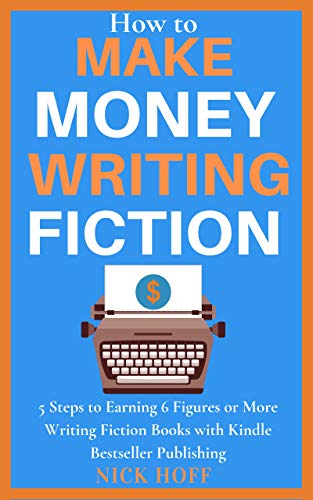
No longer available at Amazon.
Available at Barnes & Noble, iBooks, Kobo, Scribd, and 24 Symbols.
How to Make Money Writing Fiction*
Disorganized Conglomeration of General Book Marketing Information
With the variety of marketing and writing books on the market, I can safely tell you to look elsewhere if you’re wanting solid advice about making money writing fiction. This book is a hot mess in many ways. In general, the information within is mostly what you can find in many other places, often for free; no new ground here. He also doesn’t go into any depth at all; just when it starts to get interesting, he says that he can’t go into detail even about his own story (sometimes also suggesting other, outside reading; Kindlepreneur seems to be a favorite site), and moves on to the next subject. This book mostly appears to be an advertisement for his free email course on book marketing; I think it was mentioned no less than four times in the book, in the beginning, the end, and even interrupting the middle. Of course, that links to a pricey, more expanded version. Some information in the book is just wrong as well, as there have been recent shifts in the Amazon search algorithm. Even though the book purports to be about selling fiction, only in a few places does he actually mention fiction, like in the section on genre; the rest of the book has general information that could apply to any book. The book is poorly organized as well, which is only made worse by the author jumping from topic to topic quickly. The entire text is all so poorly formatted for e-reading. The table of contents is a mixed-up jumble. The book comes across as a thrown-together grab bag of information from a variety of sources that is solely meant to lead the reader to further engage with the author.
Options Trading for Beginners by Tim Shek
Available at Amazon only
Free with Kindle Unlimited
Options Trading for Beginners*
Well Organized, But May Be Confusing for True Beginners
This book is well organized, which I always appreciate in a nonfiction book. The author starts with the basics, first explaining the concept of options and then defining terms used in options trading. Then he goes into covered calls and even gives a step-by-step way to do the sell and the buy version of this. He then talks about buying and selling puts. The book ends with advanced strategies and information about bull and bear markets (and how to profit with either). I felt like the book needed more clarity to be fully accessible for true newbies to option trading. The definition section is definitely a good idea, but I found the definitions confusing. The book definitely had some issues with grammar, punctuation, and usage. I don’t know enough about options trading to say if what he writes is good information or advice, but I do appreciate that he does address tricky issues like volatility and risk as well as how to be careful.
How Probate Works by Anthony S. Park
Available at Amazon only
Free with Kindle Unlimited
How Probate Works*
Perfect Guide to the Probate Process
How wonderful to come across a nonfiction book that promises precisely what it delivers! As the title says, this book is all about how probate works, and as the subtitle says, it is for executives, heirs, and families. The book starts with a definition of probate and other terms that are a part of the process. Then he goes into the beginnings of the probate process and follows with how to settle and close an estate. Ending chapters are specifically for executors and heirs. The last chapter looks at specific difficult situations. Each chapter ends with key takeaways. Each chapter is full of examples, so you can see that the ideas that he talks about in action. Probate is tricky business–complex, lengthy, and potentially expensive–and people have to handle it at probably one of the most challenging points in their lives, when they’re grieving someone they cared about. This straightforward, no-nonsense book is the perfect antidote so you don’t have probate overwhelm.
The Lost Book of the Grail by Caitlin Matthews and John Matthews
Available at Amazon, Barnes & Noble, iBooks, Kobo, Google Play, Scribd, Thalia, Mondadori, Angus & Robertson, Indigo (Chapters), and Bol.de
The Lost Book of the Grail*
Excellent Blend of Scholarship and Spirituality
I’ve long been a fan of John and Caitlin Matthews’ writings on pagan topics (some 20 years). They have an excellent way of combining scholarship and spirituality that appeals to both my head and heart. This book is no exception. It is about a recently discovered text called the Elucidation, which is an early medieval version of the Grail myth. This version of the story shows the ties of the story to the pre-Christian world. The authors not only present the text itself, but give the context for it within the greater body of Grail literature. They analyze the text and also further look at the themes brought up within the text, giving insight into how its ideas can resonate with personal spiritual practice. This adds so much to what we think of as the Grail story. Another thought-provoking look at the Celtic roots of culture and spirituality by these authors.
Assertiveness Training by Keith Coleman
Available at Amazon only
Free with Kindle Unlimited
Assertiveness Training*
Big on Assertiveness, Not So Much on the Training
This is a relatively short book that purports to be about assertiveness training. I thought the book was heavy on the assertiveness, but not quite as focused as I would have liked it to have seen on the training aspect. The author seems to spend much of the book talking about many aspects of assertiveness, like why we may not be assertive or about how confidence impacts assertiveness, but not a lot of time until the end of the book on specific practices one can use to exude confidence and be more assertive. I didn’t find that first part of the book too terribly helpful, but I did like the practical suggestions at the end. I think if someone were having issues with assertiveness of self-confidence, they might find some of the tips and techniques of benefit.
Used To Build My Websites



NetGalley Badges