Reading Fanatic Reviews
Romantic FantasyMe, Myself, and Ideas by Carrie Anton and Jessica Nordskog
Available at Amazon, Barnes & Noble, iBooks, Kobo, Mondadori, Angus & Robertson, and Indigo (Chapters)
Me, Myself, & Ideas*
Some Ideas about How To Brainstorm by Yourself
In these modern times of solopreneurs, freelancers, and those who are interested in developing side hustles, this book means to guide the reader about how to do solo brainstorming. This might seem like an impossible phrase, but it is really about finding the ideas and answers within yourself to problems you might face in your solo business career since you don’t have the support of a group. The authors are like cheerleaders, using bright colors, nonlinear page design, and sometimes wacky ideas in an attempt to get you to dig deep for them.
The first couple of chapters are about what to do before you brainstorm: setting ground rules, thinking about your personality in regard to brainstorming, setting up your space, and getting out of your common work-a-day headspace. The longest chapter is the one on brainstorming itself, where the authors set up models for how to structure your approach to brainstorming in the guise of assignments. The last two chapters are about what to do after your brainstorming session, letting it mellow and then coming back to decide what you might want to work with.
I thought the book was at times a little too over-the-top. Some ideas are so zany that I couldn’t see the practicality of them. There are certainly nuggets here that will help you as you try to come up with ideas, but it does take some work to separate the wheat from the chaff. I think a shorter book would have been better, forcing the authors to drill down and write in a focused fashion.
That said, if you are working for or by yourself and needing to come up with ideas, this book could give you some structure in how to best approach this.
In Darkest Days May Blossom by Leila Snow
Available at Amazon only
Free with Kindle Unlimited
In Darkest Days May Blossom*
Can Love Survive in the Face of Harsh Realities?
Jonathan first sees Charlotte as she’s being beaten nearly to death buy constables for a crime that she didn’t commit. As a young gentleman, he is appalled her treatment and steps in to help, ultimately saving her life. These unlikely people fall for each other, and the book details Charlotte’s treatment in the legal system of late 18th century England.
Will Jonathan continue to stand by Charlotte? How was she fare at the hands of this seemingly merciless system?
Oh, my goodness! What a book! The author was able to draw me into this harsh world right away. Both Jonathan and Charlotte have incredible self-awareness as they acted and reacted to forces and circumstances beyond their control. As Jonathan saw that first day, Charlotte does have an incredible depth of character and inherent dignity that seem at odds with her circumstances as a poor orphan child. Jonathan, too, is different from—as Charlotte might say—a lily-handed toff. My goodness, what Charlotte suffers in prison as well as at the mockery of a trial! It’s hard not to feel for her and the injustice of her circumstances, first out in the real world and in prison as well. The author has done a skilled job in writing with such emotional honesty for both characters. I couldn’t help but be sucked in nor did I want to put the book down until I was finished. The end indignity—after all that she had already suffered—nearly broke my heart, but I was so thrilled when she finally triumphed.
This is an engaging and sometimes difficult read. The words themselves are easy enough, but the harshness of Charlotte’s world that they convey make a difficult indeed. Still, this was so masterfully done that I wholeheartedly recommend this book
Jane Hates Her Job by Tim Wilke
Available at Amazon only
Free with Kindle Unlimited
Jane Hates Her Job*
Guide to Getting Better Employee Engagement
In this book, author Tim Wilke discusses 24 strategies that will help improve employee engagement. The first part of the book has the manager do some assessment about the current level of engagement that the staff has. In this part, he also discusses the cost of disengagement as well as giving the big picture of the 24 strategies and how to apply them. Part 2, the bulk of the book, lays out the 24 strategies. They range from very simple (like saying hello to your staff every morning) to ones that are a little more vague about how to implement (like showing respect to employees) to ones that would require corporate culture change (like doing away with annual performance evaluations).
In each chapter about a strategy, he discusses research sometimes and also has you ponder your own experience or made-up scenarios that give insight into the strategy. He often tells what’s in it for management regarding the strategy, and he always ends by showing what personal needs of the employee are addressed by the particular technique. Sometimes, he gives detailed descriptions about what to do, and other times, they are more general.
For the most part, the strategies he suggests should be common sense for managers. Having worked in several larger organizations myself, I know that common sense is not so common, particularly with certain managers and typically more apt to be absent in a large organization. There are definitely dangers in misinterpreting or poorly implementing some of these strategies; the author does caution about some of these pitfalls. I’m particularly thinking about the “management by walking around” strategy. I had a manager who did this, but she used it to micromanage and belittle employees; the author does mention this as a “don’t.”
I would have liked to have seen more consistency in the way each strategy chapter was arranged. As you read through the strategies, except for knowing the end needs-met list, there’s no expectation about what you might learn about the topic. I think each chapter should have had a structure like this, if possible: any research that backed the idea up, case studies, imaginary situations, reflecting on your own knowledge of this strategy from your own life, what management gains, what employees gain, how to implement the strategy, and the needs list.
I think the cover and title of this book aren’t appropriate. The picture is shocking to look at, but it isn’t professional and doesn’t reflect the serious nature of the book. The title seems irrelevant; one should have been chosen that reflected what was within.
By the way, for the American readers out there, the writer is Australian, so some of the quotes, research, and facts reflect that. However, the concept of employee engagement is universal in its application.
Linked Across Time: Volume 1 by Dawn Brower
Available at Amazon, Barnes & Noble, iBooks, Kobo, Mondadori, Angus & Robertson, and Indigo (Chapters)
Linked Across Time: Volume 1*
Unbalanced Set of Novellas
This is a collection of the first three novellas of the Linked Through Time series by Dawn Brower. There are also excerpts from the next book in the series as well as the first book of another series.
Book 1: Saved by My Blackguard: In 1987, Paul was told that he needed to take a vacation because he was killing himself with overwork. In 1722, Lady Evelyn with sent on a ship from St. Kitts to England so she may finally be wed to her betrothed, a duke. Soon, pirates overtake her ship, and she is eventually thrown into the sea by one of them because they believe having a woman on a ship is bad luck. In a time slip, Paul and Evelyn end up on the same beach in 1722. They have an almost instant attraction to each other. How will this work out with the time difference? Will Paul make it back to 1987? This is a relatively quick novella, so unfortunately, characters couldn’t really be developed fully, and the romance plot was on hyperspeed. It’s a fascinating enough premise for a book that I think it could have been expanded into a novel quite easily. I thought, too, that Lady Evelyn had way too much of a modern sensibility about men and sex; she did not come across as a young woman who was born at the turn of the 18th century in 1700. As a nurse, I can say that Paul’s visit to the doctor is like nothing that ever happens between patient and physician, first the detailed advice and then also the prognoses. Unfortunately, this book was riddled with grammar, punctuation, and usage errors. It has awkward phrasing as well and unnatural sounding dialogue. The text felt a little choppy, especially in narrative sections that were meant to show the passage of time. Rating 3/5
Book 2: Searching for My Rogue: Oh, my gosh! What a fun read this is! Alys is a smart-mouthed American from Baltimore in 2015. Her spoiled sister, Regency, is having a Regency themed wedding the estate of Bradford, the Duke of Weston. While there, Alys takes a tumble off a cliff and into Regency England. The Regency duke, James, has recently returned from the Napoleonic Wars, suffering in both mind and body. He finds her on a beach, nearly unconscious, near his estate. He takes her back there and calls a doctor. The banter between these two is so amusing. Alys is so funny and sarcastic as she’s trying to figure out what’s going on, where precisely she is, and who this man who looks so much like Bradford is (the duke in modern portion). The Regency duke at first doesn’t understand things like her strange shoes and some of the odd words and phrases she uses. Their heated discussion even becomes physical! He thinks she’s mad until she shows him her driver’s license that shows her birthdate. This book didn’t seem to have as many problems with grammar and punctuation as the other one. It was just a deliciously fun read. My only wish is that were a novel and not a novella, as I would have loved to have seen more about both of these characters. Rating 5/5.
Book 3: Seduction of My Rake: This is Regina and Bradford’s story. The prologue sets up that Regina’s marriage to Trenton is already on the rocks after just a few months; they will be divorcing. Regina can’t quite let go of the disappearance of her sister Alys, so she goes back to the Duke of Weston’s estate to look into it. She and the duke have an attraction to each other (almost love-hate), which they pursue, along with answers about Alys. I didn’t particularly like this book because of a few factors. First, I just didn’t like the characters of Regina and Bradford. They’re not very nice people, and for people who are supposed to be starting to care about each other, they treat each other abominably. This book, too, takes place wholly in the present, unlike the previous two. The principals’ banter, but it isn’t nearly as amusing as book two because it seems more hateful. There were some errors in grammar and punctuation, but they were not as marked as the first book and not quite as good as the second. Rating 3.5/5
So, how are these stories “linked through time”? Paul and Evelyn of the first book are the parents of Alys and Regina of the second two stories. Alice is adopted, and Regina is their natural child, avoiding the pesky problem of Regina and Bradford’s future children have a multiple-times great-grandmother who is also their aunt.
The Darkness by Brittney Leigh
Available at Amazon only
Free with Kindle Unlimited
The Darkness*
Bulwark from a Teen’s Perspective
This is my third book in the Bulwark anthology, and it is certainly different from the ones by Brit Lunden. This is actually a YA novella. We see Bulwark through the eyes of a teenager keeping a diary. Strange things are afoot at Bulwark’s high school, including a peculiar smell coming out of a locker. What’s going on at the high school?
This book had me for the first 20%, as I thought, finally, I had found an author who could do diary format correctly. I’m always a bit disappointed when authors writing in this style break out into dialogue. As one who has journaled or kept a diary for a significant part of my life, I can say that I never, ever write in dialogue with full quote marks and dialogue tags. So I always hate, hate, hate it when I see it in literature. The first 20% of this book swept me back to when I kept a diary when I was in high school. I love how the author got right into this girl’s head and really give us a sense of her thoughts and emotions. But then at that 20% mark, the dialogue started creeping in. Sigh. I know an author might not want to keep strictly to the diary format for literary purposes, but if you’re going to break into dialogue, why not make the book a mixture of proper scenes and then diary musings?
That personal pet peeve aside, I found this novella to be a fun glimpse into a teenage girl’s mind. It was very creative, and I could completely identify with much of what she thought and experienced. The author did an excellent job conveying how a diary can express the rawness of emotion and thought, as well as shifting moods and beliefs.
Seduction of My Rake by Dawn Brower
Available at Amazon, Barnes & Noble, iBooks, Kobo, Scribd, 24 Symbols, Mondadori, Angus & Robertson, and Indigo (Chapters)
Seduction of My Rake*
Love-Hate Relationship Between Hero & Heroine
This book won’t make sense unless you read the previous book in the series, Searching for My Rogue. It is Regina and Bradford’s story. The prologue sets up that Regina’s marriage to Trenton is already on the rocks after just a few months; they will be divorcing. Regina can’t quite let go of the disappearance of her sister Alys, so she goes back to the Duke of Weston’s estate to look into it. She and the duke have an attraction to each other (almost love-hate), which they pursue, along with answers about Alys.
I didn’t particularly like this book because of a few factors. First, I just didn’t like the characters of Regina and Bradford. They’re not very nice people, and for people who are supposed to be starting to care about each other, they treat each other abominably. This book, too, takes place wholly in the present, unlike the previous two books of the series. The principals’ do banter, but it isn’t nearly as amusing as book two because it seems more hateful. There were some errors in grammar and punctuation, but they were not as marked as the first book and not quite as good as the second.
The Red Riding Hoods by C. J. Laurence
Available at Amazon only
Free with Kindle Unlimited
The Red Riding Hoods*
Much Ado about the Red Riding Hoods
Katana Kempe is the daughter of a prominent family who hunts and kills wolves and werewolves. We first meet her as a young girl who wants nothing more than to become a hunter like her six brothers. Her father frowns upon this because he believes the duty of the females of the family is to further the family bloodline. Since hunting is so dangerous, he doesn’t want to risk losing a female in such a way. (Although, I have to say, it seems like her brothers, as there is so many of them, would be able to fulfill the task of creating the next generation!) After some difficult years, she eventually gets her way.
The world-building is complex and interesting. The whole background for the Red Riding Hoods is imaginative. There is a fair amount of intrigue in the book as well as some surprises. More is going on than merely hunting wolf creatures.
From the earliest times in the book, I didn’t like Katana. She is rude and physically violent, even with her father. She doesn’t always think before she acts and can be quite cruel. When I first looked at the cover, I assumed it was going to be a story that took place in a timeless fantasy realm. But this is not the case. Instead, the Kempes live in the modern world–with Hello Kitty and cellphones–but they also exist within a secret society that has rules that are more akin to 200 years ago. So it seems an odd mishmash of contemporary world and fantasy world. In this context, I found the language jarring. With so many fantasy and paranormal elements, the use of modern words and phrases just doesn’t feel right, even though this supposedly takes place in modern times.
Parts of the book are written through the eyes of an omniscient narrator, which I don’t personally find to be a good technique for contemporary writing. It lends itself to telling rather than showing and can be distancing, as well, to the reader.
Because I could never entirely sympathize with Katana or reconcile this contemporary yet fantasy-world, I didn’t find this an enjoyable or satisfying read.
The Case of Billy’s Missing Gun by S. J. Slagle
Available at Amazon, Barnes & Noble, iBooks, Kobo, Scribd, Mondadori, Angus & Robertson, and Indigo (Chapters)
The Case of Billy's Missing Gun*
Missing Gun Plays Second (or Third) Fiddle
Private investigator Lucy James has had a few cases, but not a lot of money is coming in. A man hires her to try to track down a missing gun, which he states belonged to Billy the Kid. Lucy’s dad gets fired from his job as a children’s television show presenter. Lucy’s best friend is getting married and involves Lucy in the planning. Lucy’s on-again-off-again boyfriend shows up as well.
Will Lucy find the missing gun? Will it be Billy the Kid’s gun? What will her father do about his job? What other people and events will keep Lucy from focusing on her career?
Unfortunately, this book is more cozy than mystery with all the peripheral events going on in Lucy’s life that seem to take precedence over her job of finding the gun. I think sometimes it is hard for cozy mysteries to balance both aspects of the genre. I would have liked to have seen the more action and conflict in general and more about the gun that’s mentioned in the title specifically. Instead, the book seems to focus more on Lucy’s private life with all that is going on with her father, her friend, and her boyfriend.
The book has more than the typical number of issues with grammar, punctuation, and usage. Commas seem to be specifically problematic, as they were always missing around the coordinating conjunction that joins two independent clauses in a compound sentence. The use of hyphens did not follow standard usage rules. The book was rife with false subject and impersonal passive sentence constructions. There was awkward phrasing as well (“My open mouth closed and frowned”), and an over-reliance on certain pet words like *smirk*. Smirk and sneer are two words that I think are overused in fiction, and they were overused here; once, both were used in the same sentence!
The book was also a strange combination of narrative prose and dialogue in a couple of different ways. It is a pitfall of first-person perspective that there can be long narrative prose passages without any breaks of short paragraphs or dialogue. Yet, there were some sections of the narrative prose were too choppy, with a lot of single line paragraphs or short paragraphs in a row. These alternating issues with narrative prose happened often in this book, which made it more difficult to read. The dialogue sections had the latter problem as well. These sections were often just line after line of short back-and-forth between characters. Also, there didn’t seem to be much to distinguish the speech between different characters.
An Archmage’s Destiny by Marie-Claude Bourque
Available at Amazon, Barnes & Noble, iBooks, Kobo, Scribd, Mondadori, Angus & Robertson, and Indigo (Chapters)
An Archmage's Destiny*
Simple Task Becomes Dangerous
Attorney Bryce thinks she has a relatively simple task in front of her. She’s to deliver a message—and possibly a magical dagger—to Knight, part of the magical family that she represents. Knight must simply return home for a visit, she states, to obtain the dagger that his father knows will help him in his quest to keep Seattle safe from evil. Knight has no desire to do his father’s bidding and turns down the dagger. As Bryce is trying to tell him about the clause if he says no, they are attacked by shadow creatures who take a fair amount of life force from her. Now thrown into a situation that neither of them could have foreseen or want, they are placed on a path that puts them repeatedly into further danger.
The author did a fantastic job of pulling me right into the story. It was told in alternating viewpoints between Bryce and Knight. First up is Bryce, and she comes across as an uptight Eastern seaboard lawyer who wants to keep it professional and sees the task as a stepping stone to doing more meaningful work for the family. Knight is much than more his initial appearance, which seems to be that of a bad-boy biker. The author showed skill in having both Bryce and Knight reveal some of their histories right at the start without it feeling like she was doing an information dump.
Along the way, both learn much about themselves and each other. Knight is able to get a deeper understanding of his family. The pacing was tight, and they had to face danger on several fronts. Their chemistry sizzles off the page right from the start. I love how right away he was protective of her even if it wasn’t always in his own best interest. Their relationship, as well as the story, has a few surprising twists and turns.
The story is immediately engaging, and if you enjoy fast-paced paranormal adventures with secrets and dangers, you might enjoy this book.
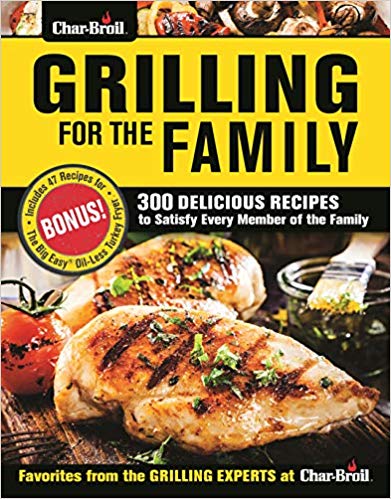
Char-Broil Grilling for the Family by Editors of Creative Homeowner
Book Link
Paperback edition only
Available at Amazon and Barnes & Noble
Char-Broil Grilling for the Family*
Bountiful Cookbook Bursting with Grilling Recipes and Tips
In this big, colorful cookbook put out by Char-Broil, you will find over 300 recipes to add to your grilling repertoire as well as practical information about grilling and healthful eating.
The book has a surprising amount of extra information for a cookbook. There’s a large front section with a variety of tips, from choosing a grill to standard cooking times to healthful eating. Chapter 12 has more information about their infrared oil-less turkey fryer (which can be used for more than just turkey).
The recipes themselves include the typical big meats and spins on classic grilling fare (like hamburgers) as well as more unusual dishes like grilled pizza (even a breakfast one!) and quesadillas. There are also chapters about breakfast from the grill, appetizers and snacks, vegetables and sides, and desserts. Most recipes use a handful of readily available ingredients; the recipes appear straightforward in technique, though some might not have enough information for an inexperienced griller. I received a copy well in advance of the publication date, so I hope some recipes will be edited to include more technique information as well as standardize the extra information about each recipe (prep/grill/cook times, servings). Except for the marinades and sauces chapter, every recipe has a photo—even though some recipes don’t show the completed dish but rather the ingredients at some stage of the preparation. At the start of each chapter, a featured recipe is shown along with instructions on how to prepare it with young children or a teenage cook.
Most of the recipes in this book use the grill, with the most significant exception being in the chapter on marinades, sauces, and rubs. Scattered, though, throughout the book are recipes that don’t use the grill. I’m wondering if those would have been better placed in a separate chapter just for non-grilled sides and accompaniments. Some recipes, too, could be made on the grill or on the stovetop or in an oven. It would have been nice if these recipes had directions those options for those times of the year when grilling is impractical.
Some of these recipes look like very fun ideas, like the grilled angel food cake s’mores (the photo alone is drool-worthy!), grilled potato salad, and a variety of recipes that creatively use bread. Some recipes don’t require grilling for too long or have only one ingredient that is grilled, so they wouldn’t necessarily make sense to be the only recipe to fire up the grill for, yet if the grill is already going, they can make great additions to a meal.
If you enjoy grilling, you might enjoy this bountiful cookbook that will supply you with new ideas for grill-time dishes.
Used To Build My Websites




NetGalley Badges